What is a Certified Nurse-Midwife?
A CNM is a graduate-educated Advanced Practice Registered Nurse who specializes in pregnancy, birth, postpartum recovery, and reproductive health. In Arizona hospitals, CNMs are primary maternity clinicians with full prescriptive authority and collaborative OB/GYN backup.
Path to practice
- 1
Registered Nurse foundation
A CNM first becomes a Registered Nurse (RN), building core skills in assessment, medication safety, and acute care before midwifery graduate training.
- 2
Graduate midwifery education
CNMs complete an accredited Master's (MSN) or Doctoral (DNP) midwifery program with extensive supervised clinical hours in prenatal, intrapartum, postpartum, and well-woman care.
- 3
National board certification
Graduates pass the American Midwifery Certification Board (AMCB) examination to earn the CNM credential and maintain certification through ongoing continuing education.
- 4
Arizona APRN licensure
In Arizona, CNMs are licensed as Advanced Practice Registered Nurses with full prescriptive authority. They practice under Arizona Board of Nursing rules as independent APRNs.
- 5
Hospital privileges & team integration
Hospital-based CNMs obtain admitting privileges at specific labor & delivery units, join medical staff processes, and practice within collaborative models that include 24/7 OB/GYN backup.
What CNMs actually do
Preconception & prenatal care
Confirm pregnancy, order labs and imaging as indicated, monitor growth and blood pressure, screen for gestational diabetes and preeclampsia risk, and spend time on nutrition, mental health, and birth preferences.
Labor & birth in the hospital
Provide continuous or near-continuous labor support, guide movement and positioning, order epidurals and other analgesia, interpret fetal monitoring, and attend vaginal birth when clinically appropriate.
Postpartum & newborn transition
Support Golden Hour skin-to-skin, delayed cord clamping when safe, lactation initiation, bleeding surveillance, and early recovery teaching before handoff to pediatric and postpartum teams.
Gynecologic & well-woman care
Many CNMs provide annual exams, Pap testing, contraception counseling, STI care, perimenopause support, and primary reproductive health visits across the lifespan, not only during pregnancy.
Arizona note: CNMs practice as independent APRNs under Arizona Board of Nursing rules. Hospital privileges and on-site OB collaboration are separate institutional arrangements that keep surgical and high-acuity care available without leaving the building.
Career path note: Many people enter CNM education as career changers or second-degree students. National certification data show a large share of new certificants had only a few years (or no years) of nursing work before midwifery school. Read who becomes a CNM.
CNM vs other midwife titles
"Midwife" is not one license. Use this table to separate hospital CNMs from community and home-birth focused credentials before you choose a care model.
Certified Nurse-Midwife (CNM)
Education
RN + Master's or Doctoral midwifery program; AMCB certification
Typical setting
Primarily hospitals and birth centers; also clinics
Arizona notes
APRN license; full prescriptive authority; independent practice under AZBN rules
Epidural access
Yes, in hospital settings via anesthesiology
Certified Midwife (CM)
Education
Graduate midwifery program without requiring RN path; AMCB certification
Typical setting
Varies by state authorization
Arizona notes
Credential recognition differs by state; confirm current Arizona licensure pathways
Epidural access
Setting-dependent; hospital practice less common than CNM
Certified Professional Midwife (CPM)
Education
Midwifery education oriented to community birth; NARM certification path
Typical setting
Home birth and freestanding birth centers more often
Arizona notes
Different regulatory pathway from CNM APRN licensure
Epidural access
Not available in home settings; transfer required for hospital epidural
Licensed Midwife (LM) / community midwife models
Education
State-specific training and licensing requirements
Typical setting
Often community or home birth focused
Arizona notes
Distinct from CNM hospital practice; scope and settings differ under state law
Epidural access
Hospital transfer required for epidural and most advanced interventions
When hospital CNM care may not be the primary model
High-risk conditions needing specialist leadership
Significant cardiac disease, complex twins or higher-order multiples, placenta accreta spectrum, severe preeclampsia early in pregnancy, or other conditions managed primarily by maternal-fetal medicine often need physician-led care. Ask whether any midwifery co-management is still appropriate.
You specifically want physician-only prenatal visits
Some people prefer every visit with an OB/GYN. That is a valid preference. Collaborative practices can still offer physician-primary schedules.
You are committed to planned home birth
Hospital CNMs do not replace community midwives for planned home birth. If home birth is your goal, seek appropriately licensed community midwifery care and understand transfer plans to hospital if needed.
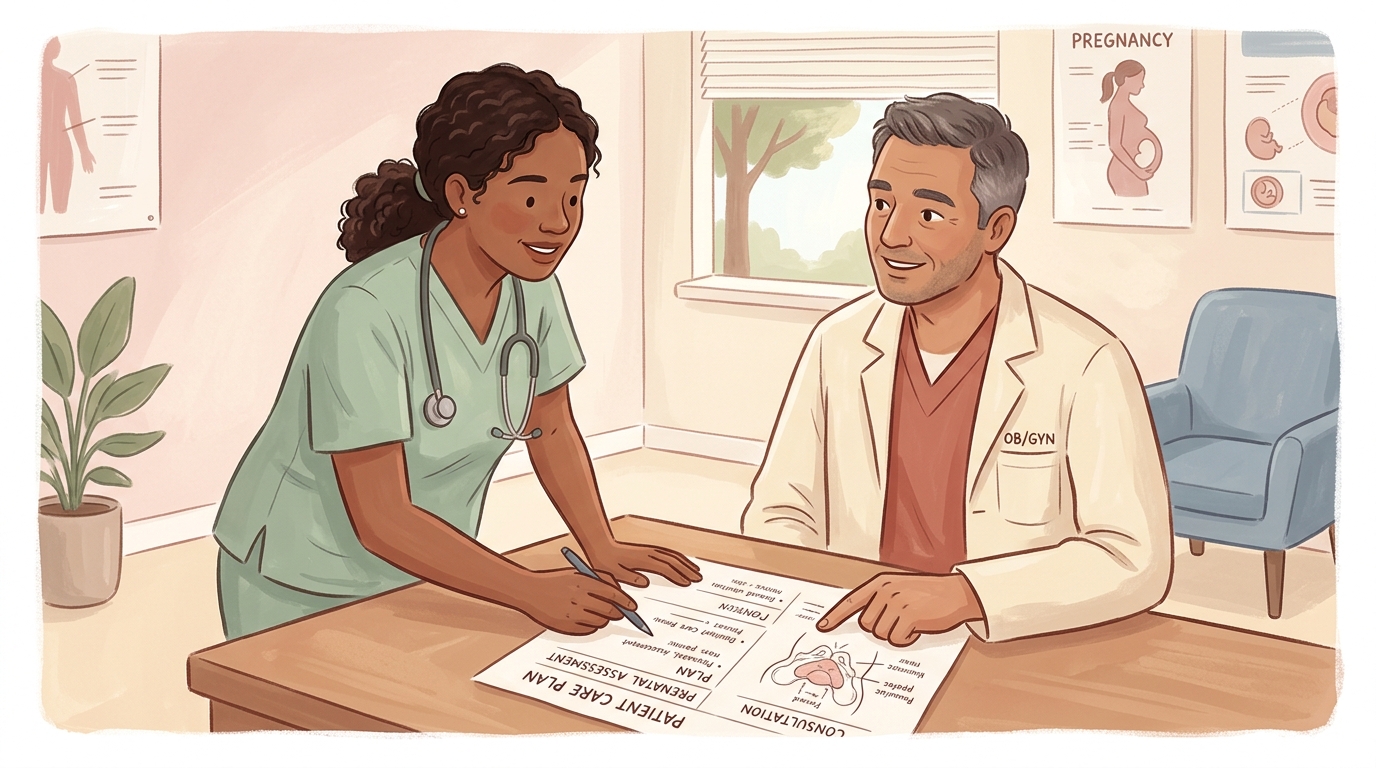
The Hospital Collaborative Care Model
See how hospital-based Certified Nurse-Midwives (CNMs) and OB/GYN physicians partner to provide low-intervention care with 24/7 emergency medical safety.
Certified Nurse-Midwife (CNM)
High-Touch Physiological Care
- Continuous bedside presence during active labor.
- Specialized non-pharmacological pain techniques.
- Significantly lower primary cesarean rates.
Accredited Hospital Facility
Advanced Clinical Technology
- 24/7 On-site anesthesiology for epidurals.
- Wireless telemetry fetal monitoring systems.
- Level III/IV NICU & neonatal specialists steps away.
OB/GYN Physician Team
24/7 Medical & Surgical Backup
- On-site hospitalist OB physicians available 24/7.
- Immediate co-management for high-risk conditions.
- Instant emergency surgical readiness if required.
How Collaborative Care Functions in Real Labor
Select a clinical scenario below to see how midwives, doctors, and hospital facilities coordinate.
Scenario: Low-Risk Physiological Labor
Midwife (CNM) Role
Primary care provider continuously at bedside, facilitating movement, position changes, hydrotherapy, emotional encouragement, and direct delivery.
OB/GYN Physician & Hospital Role
On-site 24/7 in hospital unit, briefed on labor progress, available for instant consultation if needed.
Clinical Result & Safety Outcome
Satisfying physiological birth with reduced intervention rates, intact perineum, and immediate Golden Hour skin-to-skin.